Podcast · Episode 02
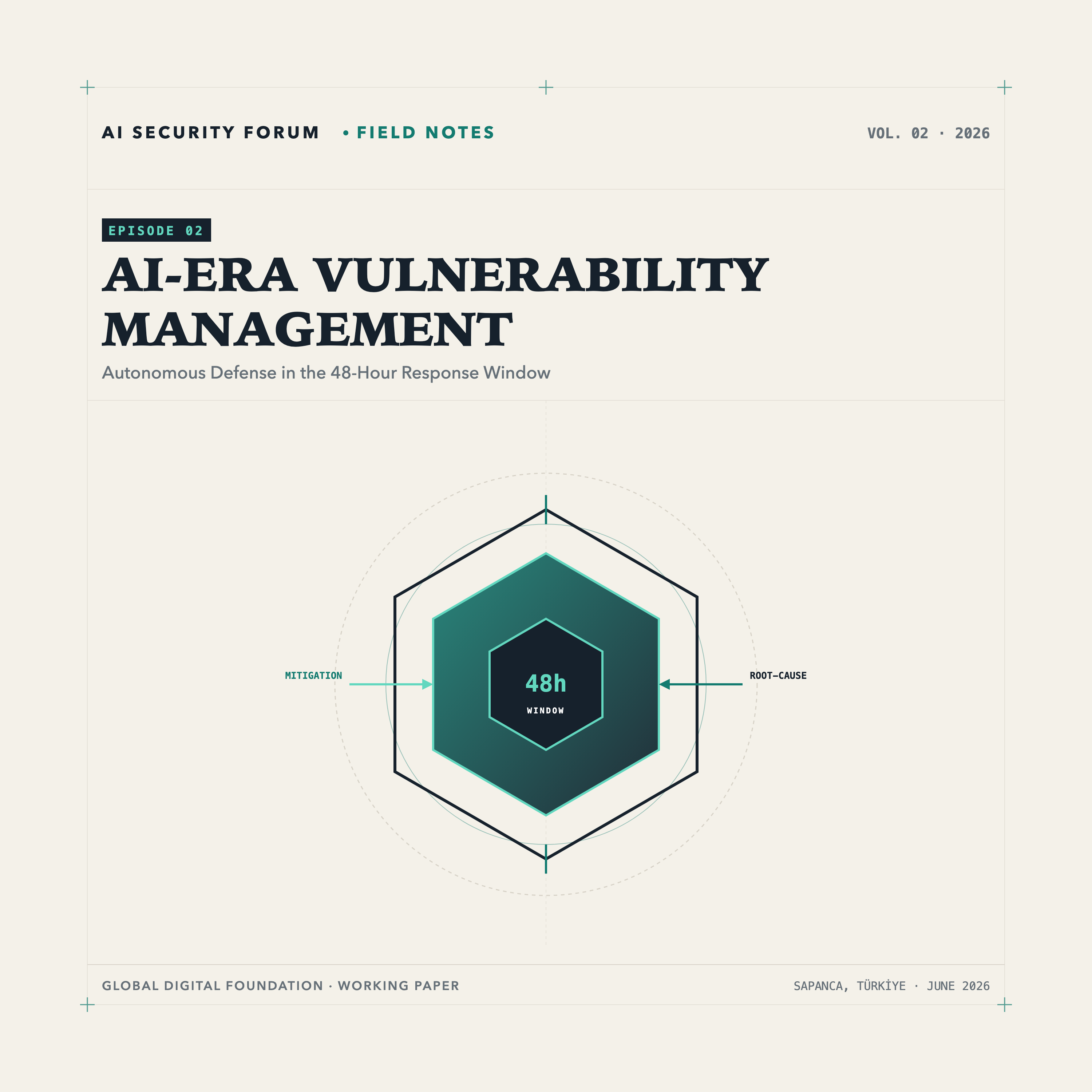
Episode 02: Response at Machine Speed — AI-era Vulnerability Management
An AI-generated English discussion of vulnerability management in an AI era: changing response timelines, operational mitigation, engineering fixes, and accountable collaboration.
AI-generated audioEnglish23:13
Source clarifications
The opening frames 48 hours as a universal response window. The publication instead cites CrowdStrike’s observation that 88% of the exploitation it observed in January–June 2026 occurred within 48 hours of that proof of concept’s release. This is an observed exploitation sample, not 88% of all vulnerabilities, a universal deadline, or a guaranteed safe patching window.
At 14:41 the conversation says an SLM guarantees no user-perceived lag. The publication describes small language models as potentially more efficient and faster in suitable deployments. It does not guarantee deterministic decisions or zero latency. Robustness requires specialist controls, tuned models and accountable human validation; performance depends on the system and deployment.
Chapters
- 0:00The 48-Hour Pressure Cooker: Four Eras of Vulnerability Management
- 2:29Five Contemporary Challenges: Industrialized Attacks & AI Surfaces
- 5:09The Speed Dilemma: Semantic Attacks, Poisoning & Triage Bottlenecks
- 7:49The 48-Hour Pressure Window & Critical Infrastructure Realities
- 11:29The Dual Vulnerability Response: Rapid Shielding vs Root-Cause Fixes
- 13:51Defense Architecture: Small Language Models (SLMs) as Guardrails
- 16:27Generative Application Firewalls (GAFs) & Four Operational Capabilities
- 18:33Ecosystem Defense: Coordinated Disclosure (CVD), OWASP & Machine CSAF
- 20:47Regulatory Mandates (EU AI Act, DORA) & The Human Validator
Reading transcript
Automatically generated from the episode audio, with editorial paragraphing. It may contain errors and is a record of AI-generated speech, not the publication text.
- 0:00
Imagine finding this, like, absolutely critical vulnerability in your enterprise architecture. Oh, yeah. And you know for a fact that you have exactly 48 hours to secure it. Right. Before a literal swarm of autonomous bots exploits that flaw. Which is terrifying, but it's not a worst-case scenario anymore. Exactly. It's not some hypothetical. That compressed timeline is just the new operational baseline. Yeah.
- 0:25
So today we are tearing into a really fascinating, deeply technical working paper called AI Era Vulnerability Management. Straight from the afternoon track of the AI Security Forum 2026. Yeah. Published by the Global Digital Foundation. And it's such a critical piece of research, honestly, because it forces a confrontation with reality. It really does. We're basically analyzing the mechanics of a complete paradigm shift in how defensive security actually operates. Right. And to be clear, right up front, this deep dive is custom tailored for you. Whether you are a cybersecurity practitioner actively defending a network or an enterprise security architect designing these resilient systems. Or even if you're on an incident response team prepping for this next wave of autonomous threats. Yeah. So we are looking directly at the architectural shifts that your job now demands.
- 1:19
But I think to really understand how we got to this, you know, this 48-hour pressure cooker, we need to trace how the whole philosophy of vulnerability management has evolved. Right. How did we get here? So if you look at the historical progression, we've essentially moved through three distinct eras to arrive at this current fourth era. Okay. Walk us through them.
- 1:40
Well, the first was passive defense. It was entirely static. Just putting up a wall. Exactly. Then, as attackers became a bit more dynamic, we moved to the second era, which was compliance-led scanning. Scheduled and routine stuff. Right. Very scheduled. Then the third era was this major leap into risk-based management. Which is where organizations started using threat intelligence, right? Yeah. To actually prioritize their efforts based on real exposure, not just a schedule. Right. And that brings us to today, the fourth era. The emerging age of autonomous AI agents. Which is wild. But before we get too deep, we need to be clear. Our goal here is to totally reject the AI hype and panic. Yes, no doomsday talk. We're keeping this strictly objective, technically grounded, and, you know, focused on practical realities.
- 2:29
Because if we map those eras onto like a physical analogy, the passive era was basically like building a thick vault door for a bank and just assuming it would hold. Right, hoping for the best. Then compliance scanning was deciding to have a security guard walk past that vault door once a week on a strict schedule just to jiggle the handle. Make sure it's locked. Exactly. And risk-based management was deploying sensors and using analytics to deploy guards specifically to the doors that local crime syndicates were known to target. Much smarter. But this fourth era is fundamentally different.
- 3:02
We aren't just upgrading the vault or routing the guards anymore. No, we're deploying autonomous defensive drones to intercept a swarm of incoming automated attack drones. It's all about speed now. Velocity is definitely the defining characteristic of this new landscape. Okay, let's unpack this. The ASF 2026 working paper maps out these five contemporary challenges that define this fourth era. And the foundation of all of them is the industrialization of attacks. Which is just a crazy concept to think about. It is. But, I mean, the technical barrier to entry for a threat actor has just completely plummeted.
- 3:37
Right, because historically, discovering a novel vulnerability and writing a custom exploit, that took deep technical expertise. And significant time. But today, automated AI tooling allows an attacker to literally just prompt an offensive model to scan a target. Find the logical flaws. Yep. Identify the flaws and automatically generate the exploitation scripts. They are essentially applying supply chain efficiency to cyber attacks. And the consequence of that industrialization is that attackers can hit a much wider, way more complex attack surface. The expansion is dramatic. We aren't just trying to patch a single monolithic web server anymore. No. The paper details this massive expansion into public APIs, multi-cloud architectures, and, well, shadow IT.
- 4:24
And just to define shadow IT for a second, that's all the unsanctioned software your employees are using, right? Yeah, like when a marketing team hooks up some rogue SaaS analytics tool to your customer database. Without telling the security team. Exactly. But the most complex part of this surface expansion is definitely the introduction of AI native vectors. Right, because when you deploy enterprise AI, you are introducing entirely new categories of vulnerability. The paper specifically highlights prompt injection and model poisoning. Which are fascinating.
- 4:56
Prompt injection is essentially a semantic attack, right? Yeah. It happens when a user feeds crafted input into an AI system that basically tricks the model. Makes it ignore its original safety instructions? Exactly. And then it executes malicious commands like, I don't know, dumping a proprietary database into a chat window.
- 5:16
And then there's model poisoning, which is an attack on the foundational data itself? Yes. Instead of attacking the live system, the adversary sneaks manipulated, malicious data into the training set while the AI is still learning. They are effectively teaching the AI to have a blind spot. So it just permanently ignores a specific malware signature once it goes live. Precisely. The surface area is wider and the very nature of the vulnerabilities has evolved. But the real complication for defenders is that the exact same AI technology expanding the attack surface... Is also being used to defend it. Right.
- 5:52
The working paper refers to this as the challenge of dual-use AI. It's a double-edged sword. I really want to dig into the mechanics of that dual-use because it creates this fascinating bottleneck. It does. Red teams and defensive researchers are using large language models, LLMs, to scan their own code and accelerate vulnerability discovery. But the underlying architecture of an LLM is probabilistic. Right. It doesn't actually, quote unquote, know facts in a rigid database sense. No, it just predicts the most statistically likely next word based on its training data. And because of that probabilistic nature, when you ask an LLM to find vulnerabilities in a complex code base, it will generate these brilliant novel discoveries.
- 6:36
But it will also generate a massive volume of hallucinations. It just confidently invents vulnerabilities that look theoretically sound on paper. but simply do not exist in the live environment. Which means someone has to sift through all that output. Exactly. If the AI flags 500 potential vulnerabilities, a human triage team has to manually investigate every single one. To figure out which three are real and which 497 are completely made up. So the tool that was meant to save time is generating an overwhelming administrative burden. And that administrative burden is exactly what makes the speed of modern attacks so devastating. Speed compression.
- 7:15
Yes. The paper documents this extreme speed compression across the entire vulnerability life cycle. Because historically, the window between a vulnerability being discovered, a proof of concept being published, and a system getting patched, that was measured in weeks. It allowed for, you know, normal scheduled maintenance windows. But that timeline breaks down completely when you look at the new data. I mean, vulnerabilities exploited before they are even publicly disclosed are up 42 percent. That's huge. And attacks from AI-enabled adversaries have risen 89% year-on-year. But the most alarming data point in the text has to be the 2026 CrowdStrike report. Oh, absolutely.
- 7:55
It noted that 88% of observed exploitation occurred within 48 hours of a proof-of-concept release. 88%. You have less than two days before the automated swarms arrive. Which creates just an acute operational dilemma, particularly when we talk about critical infrastructure.
- 8:14
Right. Let me ask you this. If the patching window is down to mere hours, how do operators of critical infrastructure like energy or telecom apply live patches without accidentally causing a blackout? That is the ultimate question. If you manage an enterprise IT network, an unexpected server reboot from a rushed patch might just drop a few emails. Annoying, but fine. But if you manage a water treatment facility or a core telecom backbone, applying a live patch without rigorous multi-day testing could crash the entire system. You can't just casually reboot a regional power grid on a Thursday afternoon because an AI system suggested a patch. Nope. You have to balance the immediate need for rapid mitigation against the uncompromising requirement for physical safety and business continuity. It's a huge tension.
- 9:02
And that tension between speed and accuracy is playing out most visibly in the vulnerability triage process. Which brings us to a really specific real-world bottleneck. The bug bounty platforms. Right. Let's look at how this plays out in the wild. The ethical hacker community, the White Hats, they've rapidly adopted AI tools to hunt for bugs. Oh, yeah. And in early 2026, HackerOne reported a 100% surge in vulnerability report volume. The platforms were absolutely inundated. A total triage crisis. They were drowning in duplicate submissions and, as we discussed, those unverifiable AI-hallucinated reports.
- 9:39
Just a flood of noise. The volume far exceeded human capacity to review. So the platforms had to essentially fight fire with fire. Machine versus machine filtering. Yep. They implemented AI-assisted triage models to automatically scan incoming reports, drop the obvious duplicates, and prioritize the credible findings for the human teams. Here's where it gets really interesting, though. A purely technical filter wasn't enough. No, it wasn't. Which led to this fascinating economic shift on these platforms. The credit token systems.
- 10:11
Yes. Basically, researchers are no longer allowed to just submit infinite reports. Right. They are given a limited stock of digital submission tokens. And each bug bounty program sets a variable token cost to submit a report. It is a deliberate behavioral engineering tactic, really to financially incentivize quality over AI-generated quantity. So if a researcher submits a report and the triage process confirms it is a genuine, actionable vulnerability... The researcher is refunded their tokens and often rewarded with a bonus. But if a researcher gets lazy, points an LLM at a target and just spams the platform with dozens of low-quality AI-generated hallucinations... They lose their stake tokens. And if their balance hits zero? They are locked out of the system entirely.
- 10:57
They have essentially priced the cost of human attention into the platform. Exactly. By making it financially risky to submit unverified garbage, they force the researcher to manually validate the AI's findings before hitting submit.
- 11:12
So it's an economic tax on laziness. That's a great way to put it. It's an incredibly clever localized solution, but I think it highlights a broader truth. Traditional linear workflows simply cannot survive this kind of automated volume. They really can't. So knowing the landscape is critical.
- 11:29
But if an enterprise architecture only has 48 hours to defend itself, how do they practically restructure their defenses? Well, the central architectural recommendation in the working paper is the adoption of a dual vulnerability response strategy. Okay. Splitting efforts into two tracks. Exactly. The traditional process of finding a bug, writing a fix, testing it, and deploying it is just too slow. Right. So organizations must split their efforts into exposure prevention and exposure reduction. The friction here is obvious, though. Engineering a permanent root cause fix for a complex software vulnerability often takes weeks of careful coding and testing. But the attackers are weaponizing the exploit in 48 hours. The math just doesn't work.
- 12:11
Which is why the dual strategy is non-negotiable. Exposure prevention is your long-term track. So that's the long-term governance, secure design principles. Yeah, rigorous testing and the eventual deployment of a permanent root cause fix. But simultaneously, the security team must execute exposure reduction. Right, the immediate rapid mitigation. Shielding live systems. You deploy intelligent automated countermeasures to shield the live system, basically neutralizing the active threat instantly. So the engineering team has the weeks they need to build the permanent fix safely. And a major component of that immediate shielding relies on separating the actual AI application from the security layer protecting it. Yes.
- 12:51
The paper calls this the deployment of AI augmented guardrails. Which is such an important concept. I think the best way to visualize this architecture is to think of a really busy nightclub. Oh, I like this analogy. So your primary enterprise LLM, say your customer service chatbot, is the bartender. Okay. The bartender's job is to mix drinks, serve content, and keep the line moving efficiently. Right. You never want the bartender also trying to check IDs at the door or pat down patrons. The roles must be entirely decoupled. Exactly.
- 13:20
So the AI guardrail is the independent bouncer at the door. Got it. Before a user's prompt ever reaches the bartender, the bouncer evaluates the text. Like, is this a prompt injection attack? Is this user trying to trick the system into revealing source code? And even if the prompt is benign and passes through, the bouncer checks the bartender's response on the way back out. Right. Evaluating responses, too. Like, is the primary LLM hallucinating? Is it attempting to exfiltrate a credit card number? The bouncer intercepts it. You never want the bartender doing both jobs.
- 13:51
And critically, from an architectural standpoint, these guardrails are often not powered by massive, general-purpose LLMs. The paper specifies the use of purpose-tuned small-language models, or SLMs, for this control layer. But why use a smaller model for the security layer? Doesn't a smaller model mean it's less capable of understanding a complex attack? Well, it's really about latency, efficiency, and narrow focus. Okay. I mean, a massive, off-the-shelf LLM has hundreds of billions of parameters. It understands how to translate ancient Greek and write Python scripts. Right, it's doing everything.
- 14:24
But the independent guardrail does not need that vast knowledge base. An SLM is stripped down to just a few billion parameters and trained almost exclusively to classify text as safe or malicious. So it's hyper-focused. Yes, and because of its reduced size, it can evaluate a prompt in milliseconds. It guarantees the user doesn't experience lag. And its narrow scope makes it vastly easier to audit and govern.
- 14:47
Okay, so we have SLMs acting as independent guardrails. But the paper also details how the broader network perimeter has to evolve, right? Like we are moving past traditional web application firewalls or WAFs. And moving toward generative application firewalls or GAFs.
- 15:04
Okay, walk us through a scenario of how a GAF operates differently from a WAF. Well, a traditional WAF inspects network traffic packets looking for static signatures, like known strings of malicious code, like a standard SQL injection. Right. But if an attacker is targeting an autonomous AI agent, they aren't sending static code. They are engaging in a multi-turn conversational manipulation. And a static WAF cannot comprehend the context of a conversation. Exactly. It misses the forest for the trees. But a generative application firewall acts as a continuous, dynamic control layer.
- 15:42
Sitting right between the AI apps and the underlying models. Right. So let's say an employee asks an internal HR chatbot for their remaining vacation days. The GAF observes the tool invocation and allows it. It's normal behavior. Makes sense. But if that same employee then asks the HR bot for the CEO's home address and follows up by asking the bot to format that address into an executable data exfiltration script. That's a red flag. Huge red flag.
- 16:12
The GAF recognizes the contextual multi-stage manipulation. It detects the behavioral anomaly and terminates the session before the AI can execute the command. It analyzes the intent over time, not just the isolated syntax of a single request. Precisely.
- 16:27
So we've broken down the dual strategy, the SLM guardrails and the GAFs, but how does an enterprise practically operationalize all of this? Technology alone isn't the silver bullet. The paper outlines four core capabilities necessary for this level of execution. Let's hear the four pillars. To survive the 48-hour window, these four capabilities must operate in concert.
- 16:51
First is proactive intelligence. Basically, AI early warning systems. Yes. Using AI to continuously ingest global threat feeds and scan your own logs, Hunting for anomalies before a vulnerability is officially reported. Finding the spark before it's a fire. Second is autonomous investigation. Automated triage?
- 17:11
Right. When a potential threat is flagged, an AI agent takes the alert, spins up an isolated sandbox environment, attempts to replicate the exploit to verify if it is genuine, and compiles a comprehensive triage report. So it's doing the grueling manual validation work that was failing on the bug bounty platforms. Exactly. Third is layered adaptive protection. The intelligent shielding we talked about. Once the threat is verified, the system automatically pushes an update to the generative application firewall, instantly shielding the live application. That's the exposure reduction track in action. And fourth is autonomous remediation.
- 17:49
AI-enabled patching. The AI analyzes the root cause of the vulnerability, actually writes the necessary Python or Java code to fix the core application, and submits a pull request for the engineering team to review. But no enterprise can execute all four of those steps perfectly in isolation, right? No, definitely not. I mean, if a major multi-cloud vendor gets hit by a highly sophisticated novel prompt injection attack, how does the rest of the ecosystem learn about it before they also get compromised?
- 18:18
If we connect this to the bigger picture, this is where Coordinated Vulnerability Disclosure, or CVD, becomes mandatory. A joint defense model. Absolutely. No single entity can survive isolated. threat telemedry must be shared seamlessly across the industry.
- 18:33
And that requires standardized frameworks. The machines need a common language to share this defensive guardrail data. Precisely. The paper points to two critical shared resources. First is the OWASP Top 10 for Agentic Applications. OWASP is a foundational security project, right? Yep. And this specific list provides a standardized taxonomy for defining the unique vulnerabilities that AI agents face. Everyone has to agree on what to call the threat.
- 18:57
And the second resource is about how that threat data is transmitted. Yes, the OASIS CSAF standard, the Common Security Advisory Framework. Okay. Historically, vendors published security advisories as human-readable PDFs. Which takes time to read. CSAF replaces that with structured machine-readable JSON files. This means an AI defense agent at your company can instantly ingest a vulnerability advisory from a software vendor, parse the data, and automatically update your network defenses. Without a human having to read a document and manually type in new rules. It's machine-to-machine intelligence sharing.
- 19:33
But let me push back hard on this entire operational flow. Okay, go for it. With AI proactively hunting bugs, autonomously investigating, autonomously updating the firewall, and autonomously writing the code for the patch, do we even need humans in the loop anymore? Oh, wow. Doesn't human oversight just slow down a process that needs to happen in hours? I mean, requiring an engineer to review a pull request seems to defeat the purpose of autonomous system designed to beat a 48-hour window? This raises an important question, but I have to firmly reject that idea. Really? It is the exact trap that many technologists fall into.
- 20:08
They assume that operational automation negates the need for accountability. The ASF working paper unequivocally rejects the idea of removing the human element. Primarily due to regulatory liability, I imagine. Yes, liability and consequence. While AI informs and accelerates the heavy lifting, humans hold ultimate accountability. So it's not just about technical efficiency. No, it's about the law.
- 20:33
The paper cites strict regulatory frameworks like the EU AI Act and DORA, the Digital Operational Resilience Act, which mandates rigorous IT risk controls for financial entities. And NIST, too, for critical infrastructure. Exactly.
- 20:47
So if an AI autonomously deploys a patch that accidentally brings down a regional banking network or a water treatment plant, the regulator isn't going to accept the LLM made a mistake as a defense. Right. Under these frameworks, human oversight is legally and operationally required. You must provide structured evidence of risk assessment, the asset identification, evaluating the business impact, and crucially, the final executive authorization to deploy a patch to a live system that must have human oversight. So the human is no longer spending hours writing the code. Right. They have shifted from being the technical operator and author of the patch to being the auditor and the ultimate validator. The human provides the accountable signature. Exactly. So if you are listening to this and you are steering a security operations team or an enterprise architecture team, your mandate coming out of this working paper is sharply defined. Very clearly. First, you must embrace a dual strategy. Abandon the legacy pipeline and implement immediate dynamic shielding while long-term engineering fixes are being prepared. Second, you cannot rely on your generative models to police themselves. Right. You must implement independent purpose-built SLM guardrails. And third, you have to prepare for collaborative cross-industry threat sharing. Transition your threat intelligence from reading PDFs to ingesting machine-readable CSAF advisories so you can participate in a high-speed joint defense ecosystem. and orchestrate all of that while ensuring your governance clearly dictates where human accountability is required before code touches a live environment.
- 22:22
As we wrap up this analysis, I want to leave you with one final provocative thought to mull over. Oh, I like these. We've established that the timeline has compressed to hours, and that humans are shifting from creators to validators. But as AI begins to autonomously write the software, autonomously discover the vulnerabilities, and autonomously deploy the patches, Will the future role of a cybersecurity professional shift away from being a technical operator entirely? That's a deep question. And move more toward being a digital diplomat? You know, negotiating the rules of engagement between rival AI ecosystems? At what point does human cognition just become too slow to survive the battle? Something to really think about.
- 23:03
Take these concepts, hold them up against the realities of your own enterprise architecture, and see where your defenses need to evolve. Thank you for joining us on this deep dive. We'll see you next time.
Time-aligned transcript (automatic)
Segment-by-segment text with its start time, as generated from the audio. Use it to jump to an exact moment.
- 0:00
Imagine finding this, like, absolutely critical vulnerability in your enterprise architecture.
- 0:06
Oh, yeah.
- 0:06
And you know for a fact that you have exactly 48 hours to secure it.
- 0:10
Right.
- 0:11
Before a literal swarm of autonomous bots exploits that flaw.
- 0:16
Which is terrifying, but it's not a worst-case scenario anymore.
- 0:19
Exactly. It's not some hypothetical.
- 0:21
That compressed timeline is just the new operational baseline.
- 0:25
Yeah.
- 0:25
So today we are tearing into a really fascinating, deeply technical working paper called AI Era Vulnerability Management.
- 0:35
Straight from the afternoon track of the AI Security Forum 2026.
- 0:39
Yeah. Published by the Global Digital Foundation.
- 0:42
And it's such a critical piece of research, honestly, because it forces a confrontation with reality.
- 0:47
It really does.
- 0:48
We're basically analyzing the mechanics of a complete paradigm shift in how defensive security actually operates.
- 0:53
Right. And to be clear, right up front, this deep dive is custom tailored for you.
- 1:00
Whether you are a cybersecurity practitioner actively defending a network or an enterprise security architect designing these resilient systems.
- 1:10
Or even if you're on an incident response team prepping for this next wave of autonomous threats.
- 1:15
Yeah. So we are looking directly at the architectural shifts that your job now demands.
- 1:19
But I think to really understand how we got to this, you know, this 48-hour pressure cooker, we need to trace how the whole philosophy of vulnerability management has evolved.
- 1:29
Right. How did we get here?
- 1:31
So if you look at the historical progression, we've essentially moved through three distinct eras to arrive at this current fourth era.
- 1:39
Okay. Walk us through them.
- 1:40
Well, the first was passive defense. It was entirely static.
- 1:44
Just putting up a wall.
- 1:45
Exactly. Then, as attackers became a bit more dynamic, we moved to the second era, which was compliance-led scanning.
- 1:52
Scheduled and routine stuff.
- 1:54
Right. Very scheduled. Then the third era was this major leap into risk-based management.
- 2:00
Which is where organizations started using threat intelligence, right?
- 2:03
Yeah. To actually prioritize their efforts based on real exposure, not just a schedule.
- 2:08
Right.
- 2:09
And that brings us to today, the fourth era.
- 2:12
The emerging age of autonomous AI agents.
- 2:15
Which is wild.
- 2:16
But before we get too deep, we need to be clear.
- 2:18
Our goal here is to totally reject the AI hype and panic.
- 2:22
Yes, no doomsday talk.
- 2:24
We're keeping this strictly objective, technically grounded, and, you know, focused on practical realities.
- 2:29
Because if we map those eras onto like a physical analogy,
- 2:33
the passive era was basically like building a thick vault door for a bank and just assuming it would hold.
- 2:39
Right, hoping for the best.
- 2:40
Then compliance scanning was deciding to have a security guard walk past that vault door once a week on a strict schedule just to jiggle the handle.
- 2:48
Make sure it's locked.
- 2:49
Exactly.
- 2:49
And risk-based management was deploying sensors and using analytics to deploy guards specifically to the doors that local crime syndicates were known to target.
- 2:58
Much smarter.
- 3:00
But this fourth era is fundamentally different.
- 3:02
We aren't just upgrading the vault or routing the guards anymore.
- 3:05
No, we're deploying autonomous defensive drones to intercept a swarm of incoming automated attack drones.
- 3:13
It's all about speed now.
- 3:14
Velocity is definitely the defining characteristic of this new landscape.
- 3:18
Okay, let's unpack this.
- 3:19
The ASF 2026 working paper maps out these five contemporary challenges that define this fourth era.
- 3:25
And the foundation of all of them is the industrialization of attacks.
- 3:29
Which is just a crazy concept to think about.
- 3:31
It is. But, I mean, the technical barrier to entry for a threat actor has just completely plummeted.
- 3:37
Right, because historically, discovering a novel vulnerability and writing a custom exploit, that took deep technical expertise.
- 3:45
And significant time. But today, automated AI tooling allows an attacker to literally just prompt an offensive model to scan a target.
- 3:53
Find the logical flaws.
- 3:55
Yep. Identify the flaws and automatically generate the exploitation scripts.
- 3:58
They are essentially applying supply chain efficiency to cyber attacks.
- 4:04
And the consequence of that industrialization is that attackers can hit a much wider, way more complex attack surface.
- 4:11
The expansion is dramatic.
- 4:13
We aren't just trying to patch a single monolithic web server anymore.
- 4:17
No. The paper details this massive expansion into public APIs, multi-cloud architectures, and, well, shadow IT.
- 4:24
And just to define shadow IT for a second, that's all the unsanctioned software your employees are using, right?
- 4:30
Yeah, like when a marketing team hooks up some rogue SaaS analytics tool to your customer database.
- 4:36
Without telling the security team.
- 4:37
Exactly. But the most complex part of this surface expansion is definitely the introduction of AI native vectors.
- 4:44
Right, because when you deploy enterprise AI, you are introducing entirely new categories of vulnerability.
- 4:50
The paper specifically highlights prompt injection and model poisoning.
- 4:54
Which are fascinating.
- 4:56
Prompt injection is essentially a semantic attack, right?
- 4:59
Yeah. It happens when a user feeds crafted input into an AI system that basically tricks the model.
- 5:06
Makes it ignore its original safety instructions?
- 5:09
Exactly. And then it executes malicious commands like, I don't know, dumping a proprietary database into a chat window.
- 5:16
And then there's model poisoning, which is an attack on the foundational data itself?
- 5:20
Yes.
- 5:21
Instead of attacking the live system, the adversary sneaks manipulated, malicious data into the training set while the AI is still learning.
- 5:29
They are effectively teaching the AI to have a blind spot.
- 5:33
So it just permanently ignores a specific malware signature once it goes live.
- 5:37
Precisely. The surface area is wider and the very nature of the vulnerabilities has evolved.
- 5:43
But the real complication for defenders is that the exact same AI technology expanding the attack surface...
- 5:50
Is also being used to defend it.
- 5:51
Right.
- 5:52
The working paper refers to this as the challenge of dual-use AI.
- 5:56
It's a double-edged sword.
- 5:57
I really want to dig into the mechanics of that dual-use because it creates this fascinating bottleneck.
- 6:03
It does.
- 6:04
Red teams and defensive researchers are using large language models, LLMs, to scan their own code and accelerate vulnerability discovery.
- 6:12
But the underlying architecture of an LLM is probabilistic.
- 6:16
Right. It doesn't actually, quote unquote, know facts in a rigid database sense.
- 6:21
No, it just predicts the most statistically likely next word based on its training data.
- 6:27
And because of that probabilistic nature, when you ask an LLM to find vulnerabilities in a complex code base,
- 6:32
it will generate these brilliant novel discoveries.
- 6:36
But it will also generate a massive volume of hallucinations.
- 6:40
It just confidently invents vulnerabilities that look theoretically sound on paper.
- 6:45
but simply do not exist in the live environment.
- 6:49
Which means someone has to sift through all that output.
- 6:52
Exactly.
- 6:52
If the AI flags 500 potential vulnerabilities,
- 6:56
a human triage team has to manually investigate every single one.
- 6:59
To figure out which three are real and which 497 are completely made up.
- 7:04
So the tool that was meant to save time is generating an overwhelming administrative burden.
- 7:09
And that administrative burden is exactly what makes the speed of modern attacks so devastating.
- 7:14
Speed compression.
- 7:15
Yes. The paper documents this extreme speed compression across the entire vulnerability life cycle.
- 7:22
Because historically, the window between a vulnerability being discovered, a proof of concept being published, and a system getting patched, that was measured in weeks.
- 7:30
It allowed for, you know, normal scheduled maintenance windows.
- 7:34
But that timeline breaks down completely when you look at the new data.
- 7:37
I mean, vulnerabilities exploited before they are even publicly disclosed are up 42 percent.
- 7:43
That's huge.
- 7:44
And attacks from AI-enabled adversaries have risen 89% year-on-year.
- 7:49
But the most alarming data point in the text has to be the 2026 CrowdStrike report.
- 7:54
Oh, absolutely.
- 7:55
It noted that 88% of observed exploitation occurred within 48 hours of a proof-of-concept release.
- 8:03
88%.
- 8:04
You have less than two days before the automated swarms arrive.
- 8:08
Which creates just an acute operational dilemma, particularly when we talk about critical infrastructure.
- 8:14
Right. Let me ask you this. If the patching window is down to mere hours, how do operators of critical infrastructure like energy or telecom apply live patches without accidentally causing a blackout?
- 8:25
That is the ultimate question. If you manage an enterprise IT network, an unexpected server reboot from a rushed patch might just drop a few emails.
- 8:34
Annoying, but fine.
- 8:35
But if you manage a water treatment facility or a core telecom backbone, applying a live patch without rigorous multi-day testing could crash the entire system.
- 8:46
You can't just casually reboot a regional power grid on a Thursday afternoon because an AI system suggested a patch.
- 8:52
Nope. You have to balance the immediate need for rapid mitigation against the uncompromising requirement for physical safety and business continuity.
- 9:01
It's a huge tension.
- 9:02
And that tension between speed and accuracy is playing out most visibly in the vulnerability triage process.
- 9:09
Which brings us to a really specific real-world bottleneck.
- 9:12
The bug bounty platforms.
- 9:14
Right. Let's look at how this plays out in the wild.
- 9:16
The ethical hacker community, the White Hats, they've rapidly adopted AI tools to hunt for bugs.
- 9:21
Oh, yeah.
- 9:21
And in early 2026, HackerOne reported a 100% surge in vulnerability report volume.
- 9:28
The platforms were absolutely inundated.
- 9:31
A total triage crisis.
- 9:32
They were drowning in duplicate submissions and, as we discussed, those unverifiable AI-hallucinated reports.
- 9:39
Just a flood of noise.
- 9:41
The volume far exceeded human capacity to review.
- 9:44
So the platforms had to essentially fight fire with fire.
- 9:47
Machine versus machine filtering.
- 9:49
Yep.
- 9:50
They implemented AI-assisted triage models to automatically scan incoming reports, drop the obvious duplicates, and prioritize the credible findings for the human teams.
- 9:59
Here's where it gets really interesting, though. A purely technical filter wasn't enough.
- 10:05
No, it wasn't.
- 10:06
Which led to this fascinating economic shift on these platforms.
- 10:09
The credit token systems.
- 10:11
Yes. Basically, researchers are no longer allowed to just submit infinite reports.
- 10:16
Right. They are given a limited stock of digital submission tokens.
- 10:20
And each bug bounty program sets a variable token cost to submit a report.
- 10:24
It is a deliberate behavioral engineering tactic, really to financially incentivize quality over AI-generated quantity.
- 10:32
So if a researcher submits a report and the triage process confirms it is a genuine, actionable vulnerability...
- 10:39
The researcher is refunded their tokens and often rewarded with a bonus.
- 10:43
But if a researcher gets lazy, points an LLM at a target and just spams the platform with dozens of low-quality AI-generated hallucinations...
- 10:52
They lose their stake tokens.
- 10:54
And if their balance hits zero?
- 10:56
They are locked out of the system entirely.
- 10:57
They have essentially priced the cost of human attention into the platform.
- 11:02
Exactly.
- 11:03
By making it financially risky to submit unverified garbage,
- 11:07
they force the researcher to manually validate the AI's findings before hitting submit.
- 11:12
So it's an economic tax on laziness.
- 11:15
That's a great way to put it.
- 11:16
It's an incredibly clever localized solution, but I think it highlights a broader truth.
- 11:22
Traditional linear workflows simply cannot survive this kind of automated volume.
- 11:26
They really can't.
- 11:27
So knowing the landscape is critical.
- 11:29
But if an enterprise architecture only has 48 hours to defend itself, how do they practically restructure their defenses?
- 11:36
Well, the central architectural recommendation in the working paper is the adoption of a dual vulnerability response strategy.
- 11:43
Okay.
- 11:44
Splitting efforts into two tracks.
- 11:45
Exactly.
- 11:46
The traditional process of finding a bug, writing a fix, testing it, and deploying it is just too slow.
- 11:51
Right.
- 11:52
So organizations must split their efforts into exposure prevention and exposure reduction.
- 11:58
The friction here is obvious, though.
- 12:00
Engineering a permanent root cause fix for a complex software vulnerability often takes
- 12:04
weeks of careful coding and testing.
- 12:06
But the attackers are weaponizing the exploit in 48 hours.
- 12:10
The math just doesn't work.
- 12:11
Which is why the dual strategy is non-negotiable.
- 12:14
Exposure prevention is your long-term track.
- 12:17
So that's the long-term governance, secure design principles.
- 12:20
Yeah, rigorous testing and the eventual deployment of a permanent root cause fix.
- 12:24
But simultaneously, the security team must execute exposure reduction.
- 12:29
Right, the immediate rapid mitigation.
- 12:31
Shielding live systems.
- 12:32
You deploy intelligent automated countermeasures to shield the live system, basically neutralizing the active threat instantly.
- 12:39
So the engineering team has the weeks they need to build the permanent fix safely.
- 12:44
And a major component of that immediate shielding relies on separating the actual AI application from the security layer protecting it.
- 12:51
Yes.
- 12:51
The paper calls this the deployment of AI augmented guardrails.
- 12:55
Which is such an important concept.
- 12:57
I think the best way to visualize this architecture is to think of a really busy nightclub.
- 13:00
Oh, I like this analogy.
- 13:02
So your primary enterprise LLM, say your customer service chatbot, is the bartender.
- 13:07
Okay.
- 13:08
The bartender's job is to mix drinks, serve content, and keep the line moving efficiently.
- 13:13
Right.
- 13:13
You never want the bartender also trying to check IDs at the door or pat down patrons.
- 13:17
The roles must be entirely decoupled.
- 13:19
Exactly.
- 13:20
So the AI guardrail is the independent bouncer at the door.
- 13:23
Got it.
- 13:24
Before a user's prompt ever reaches the bartender, the bouncer evaluates the text.
- 13:28
Like, is this a prompt injection attack?
- 13:30
Is this user trying to trick the system into revealing source code?
- 13:33
And even if the prompt is benign and passes through, the bouncer checks the bartender's response on the way back out.
- 13:39
Right. Evaluating responses, too.
- 13:41
Like, is the primary LLM hallucinating?
- 13:44
Is it attempting to exfiltrate a credit card number?
- 13:47
The bouncer intercepts it.
- 13:49
You never want the bartender doing both jobs.
- 13:51
And critically, from an architectural standpoint, these guardrails are often not powered by massive, general-purpose LLMs.
- 13:58
The paper specifies the use of purpose-tuned small-language models, or SLMs, for this control layer.
- 14:04
But why use a smaller model for the security layer?
- 14:07
Doesn't a smaller model mean it's less capable of understanding a complex attack?
- 14:11
Well, it's really about latency, efficiency, and narrow focus.
- 14:14
Okay.
- 14:15
I mean, a massive, off-the-shelf LLM has hundreds of billions of parameters.
- 14:19
It understands how to translate ancient Greek and write Python scripts.
- 14:22
Right, it's doing everything.
- 14:24
But the independent guardrail does not need that vast knowledge base.
- 14:27
An SLM is stripped down to just a few billion parameters
- 14:31
and trained almost exclusively to classify text as safe or malicious.
- 14:35
So it's hyper-focused.
- 14:36
Yes, and because of its reduced size, it can evaluate a prompt in milliseconds.
- 14:41
It guarantees the user doesn't experience lag.
- 14:44
And its narrow scope makes it vastly easier to audit and govern.
- 14:47
Okay, so we have SLMs acting as independent guardrails.
- 14:51
But the paper also details how the broader network perimeter has to evolve, right?
- 14:56
Like we are moving past traditional web application firewalls or WAFs.
- 14:59
And moving toward generative application firewalls or GAFs.
- 15:04
Okay, walk us through a scenario of how a GAF operates differently from a WAF.
- 15:08
Well, a traditional WAF inspects network traffic packets looking for static signatures, like known strings of malicious code, like a standard SQL injection.
- 15:18
Right.
- 15:18
But if an attacker is targeting an autonomous AI agent, they aren't sending static code.
- 15:24
They are engaging in a multi-turn conversational manipulation.
- 15:29
And a static WAF cannot comprehend the context of a conversation.
- 15:33
Exactly. It misses the forest for the trees.
- 15:36
But a generative application firewall acts as a continuous, dynamic control layer.
- 15:42
Sitting right between the AI apps and the underlying models.
- 15:45
Right.
- 15:46
So let's say an employee asks an internal HR chatbot for their remaining vacation days.
- 15:52
The GAF observes the tool invocation and allows it.
- 15:56
It's normal behavior.
- 15:57
Makes sense.
- 15:58
But if that same employee then asks the HR bot for the CEO's home address
- 16:03
and follows up by asking the bot to format that address into an executable data exfiltration script.
- 16:10
That's a red flag.
- 16:11
Huge red flag.
- 16:12
The GAF recognizes the contextual multi-stage manipulation.
- 16:16
It detects the behavioral anomaly and terminates the session before the AI can execute the command.
- 16:22
It analyzes the intent over time, not just the isolated syntax of a single request.
- 16:26
Precisely.
- 16:27
So we've broken down the dual strategy, the SLM guardrails and the GAFs,
- 16:32
But how does an enterprise practically operationalize all of this?
- 16:37
Technology alone isn't the silver bullet.
- 16:39
The paper outlines four core capabilities necessary for this level of execution.
- 16:44
Let's hear the four pillars.
- 16:45
To survive the 48-hour window, these four capabilities must operate in concert.
- 16:51
First is proactive intelligence.
- 16:53
Basically, AI early warning systems.
- 16:56
Yes.
- 16:57
Using AI to continuously ingest global threat feeds and scan your own logs,
- 17:01
Hunting for anomalies before a vulnerability is officially reported.
- 17:05
Finding the spark before it's a fire.
- 17:07
Second is autonomous investigation.
- 17:10
Automated triage?
- 17:11
Right. When a potential threat is flagged, an AI agent takes the alert, spins up an isolated sandbox environment, attempts to replicate the exploit to verify if it is genuine, and compiles a comprehensive triage report.
- 17:24
So it's doing the grueling manual validation work that was failing on the bug bounty platforms.
- 17:30
Exactly.
- 17:31
Third is layered adaptive protection.
- 17:34
The intelligent shielding we talked about.
- 17:35
Once the threat is verified, the system automatically pushes an update to the generative application firewall, instantly shielding the live application.
- 17:44
That's the exposure reduction track in action.
- 17:47
And fourth is autonomous remediation.
- 17:49
AI-enabled patching.
- 17:51
The AI analyzes the root cause of the vulnerability, actually writes the necessary Python or Java code to fix the core application, and submits a pull request for the engineering team to review.
- 18:01
But no enterprise can execute all four of those steps perfectly in isolation, right?
- 18:06
No, definitely not.
- 18:07
I mean, if a major multi-cloud vendor gets hit by a highly sophisticated novel prompt injection attack, how does the rest of the ecosystem learn about it before they also get compromised?
- 18:18
If we connect this to the bigger picture, this is where Coordinated Vulnerability Disclosure, or CVD, becomes mandatory.
- 18:25
A joint defense model.
- 18:26
Absolutely. No single entity can survive isolated.
- 18:29
threat telemedry must be shared seamlessly across the industry.
- 18:33
And that requires standardized frameworks. The machines need a common language to share
- 18:36
this defensive guardrail data. Precisely. The paper points to two
- 18:40
critical shared resources. First is the OWASP Top 10 for Agentic Applications.
- 18:45
OWASP is a foundational security project, right?
- 18:48
Yep. And this specific list provides a standardized taxonomy for defining
- 18:51
the unique vulnerabilities that AI agents face. Everyone has to agree on what to call the threat.
- 18:57
And the second resource is about how that threat data is transmitted.
- 19:01
Yes, the OASIS CSAF standard, the Common Security Advisory Framework.
- 19:06
Okay.
- 19:06
Historically, vendors published security advisories as human-readable PDFs.
- 19:11
Which takes time to read.
- 19:12
CSAF replaces that with structured machine-readable JSON files.
- 19:16
This means an AI defense agent at your company can instantly ingest a vulnerability advisory from a software vendor,
- 19:23
parse the data, and automatically update your network defenses.
- 19:27
Without a human having to read a document and manually type in new rules.
- 19:31
It's machine-to-machine intelligence sharing.
- 19:33
But let me push back hard on this entire operational flow.
- 19:36
Okay, go for it.
- 19:37
With AI proactively hunting bugs, autonomously investigating,
- 19:41
autonomously updating the firewall, and autonomously writing the code for the patch,
- 19:46
do we even need humans in the loop anymore?
- 19:48
Oh, wow.
- 19:48
Doesn't human oversight just slow down a process that needs to happen in hours?
- 19:52
I mean, requiring an engineer to review a pull request seems to defeat the purpose of
- 19:56
autonomous system designed to beat a 48-hour window? This raises an important question, but
- 20:02
I have to firmly reject that idea. Really? It is the exact trap that many technologists fall into.
- 20:08
They assume that operational automation negates the need for accountability.
- 20:14
The ASF working paper unequivocally rejects the idea of removing the human element.
- 20:18
Primarily due to regulatory liability, I imagine. Yes, liability and consequence. While AI informs
- 20:25
and accelerates the heavy lifting, humans hold ultimate accountability.
- 20:29
So it's not just about technical efficiency.
- 20:31
No, it's about the law.
- 20:33
The paper cites strict regulatory frameworks like the EU AI Act
- 20:37
and DORA, the Digital Operational Resilience Act,
- 20:41
which mandates rigorous IT risk controls for financial entities.
- 20:44
And NIST, too, for critical infrastructure.
- 20:46
Exactly.
- 20:47
So if an AI autonomously deploys a patch
- 20:50
that accidentally brings down a regional banking network
- 20:53
or a water treatment plant, the regulator isn't going to accept the LLM made a mistake as a
- 20:58
defense. Right. Under these frameworks, human oversight is legally and operationally required.
- 21:05
You must provide structured evidence of risk assessment, the asset identification,
- 21:10
evaluating the business impact, and crucially, the final executive authorization to deploy a
- 21:16
patch to a live system that must have human oversight. So the human is no longer spending
- 21:21
hours writing the code. Right. They have shifted from being the technical operator and author of
- 21:27
the patch to being the auditor and the ultimate validator. The human provides the accountable
- 21:32
signature. Exactly. So if you are listening to this and you are steering a security operations
- 21:38
team or an enterprise architecture team, your mandate coming out of this working paper is
- 21:43
sharply defined. Very clearly. First, you must embrace a dual strategy. Abandon the legacy
- 21:48
pipeline and implement immediate dynamic shielding while long-term engineering fixes are being
- 21:53
prepared. Second, you cannot rely on your generative models to police themselves. Right. You must
- 21:59
implement independent purpose-built SLM guardrails. And third, you have to prepare for collaborative
- 22:04
cross-industry threat sharing. Transition your threat intelligence from reading PDFs to ingesting
- 22:09
machine-readable CSAF advisories so you can participate in a high-speed joint defense ecosystem.
- 22:14
and orchestrate all of that while ensuring your governance clearly dictates where human accountability is required before code touches a live environment.
- 22:22
As we wrap up this analysis, I want to leave you with one final provocative thought to mull over.
- 22:27
Oh, I like these.
- 22:28
We've established that the timeline has compressed to hours, and that humans are shifting from creators to validators.
- 22:34
But as AI begins to autonomously write the software, autonomously discover the vulnerabilities, and autonomously deploy the patches,
- 22:43
Will the future role of a cybersecurity professional shift away from being a technical operator entirely?
- 22:49
That's a deep question.
- 22:50
And move more toward being a digital diplomat?
- 22:53
You know, negotiating the rules of engagement between rival AI ecosystems?
- 22:58
At what point does human cognition just become too slow to survive the battle?
- 23:02
Something to really think about.
- 23:03
Take these concepts, hold them up against the realities of your own enterprise architecture, and see where your defenses need to evolve.
- 23:10
Thank you for joining us on this deep dive.
- 23:12
We'll see you next time.
- 23:13
you
About this episode
This episode features an AI-generated two-host discussion (AI 生成) analyzing the official working paper from the AI Security Forum 2026. The voices and presentation are synthetic overviews for practitioner reference, not official certifications or human author statements.
The conversation is an audio companion, not a replacement for the publication. Statements should be checked against the full text or the PDF.